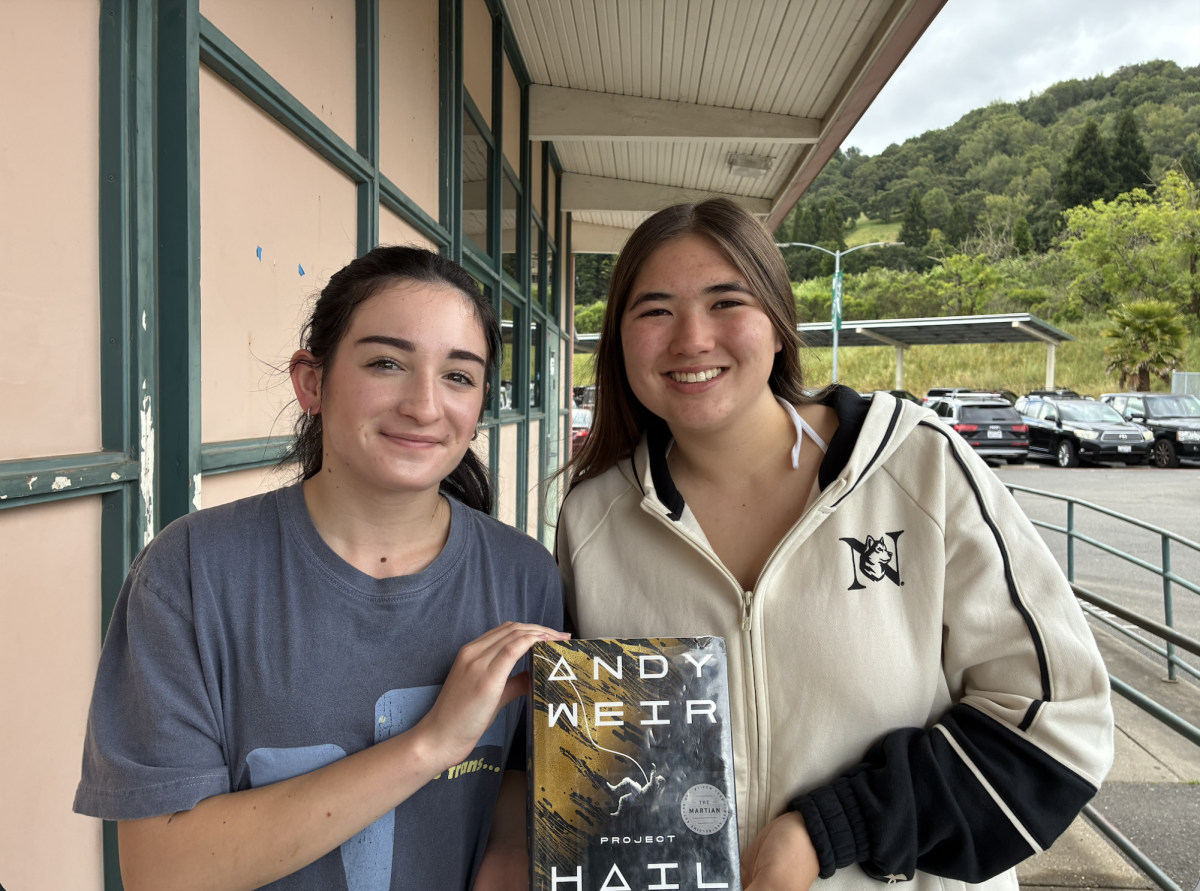
For this issue’s book review, the Mirador takes on an exciting read: “Project Hail Mary,” written by Andy Weir (To some of our dedicated readers, this name might sound familiar — on top of being the author behind the hit novel “The Martian,” Weir also wrote “Artemis,” which we reviewed back in Issue 4 of Volume 68). Published in 2021, “Project Hail Mary” follows biologist-turned-middle school science teacher Ryland Grace as he navigates space travel to save humanity from an otherworldly threat while battling amnesia. As the novel progresses, he learns more about his unique situation through periodic flashbacks that take him and the reader back to his time on Earth.
Who was your favorite character?
Nikki: My favorite character was the director of the Hail Mary mission (a.k.a. Supreme Leader of Earth): Eva Stratt. Too often have writers limited their female characters to people-pleasing, unassuming personality traits. Stratt is, instead, the very epitome of a powerful female character who is not afraid to make hard decisions in order to accomplish her goal (saving the world). No spoilers here, but one of my favorite scenes featured Stratt making an incredibly tough and surprisingly uncomfortable decision. That scene alone could have solidified my appreciation for her, but, nevertheless, I thoroughly enjoyed reading through the rest of the book as Stratt unabashedly wielded her power over any obstacles that came in her way.
Annie: Weir has once again managed the challenging task of creating an incredibly likeable protagonist. Ryland Grace follows in the footsteps of Mark Watney, the leading man in “The Martian,” as a sarcastic, hilarious narrator who puts a comedic spin on even the most dire situations. However, Weir also proved he’s not a simple, one-note writer; Watney loves to swear more than anyone, while Grace LOVES a “heck” or “gosh darn it” to protect the innocent ears of his middle school students. Grace’s irreverence to all authority figures (e.g., the iconic Eva Stratt) grounds the reader and serves as a bright spot in many of the flashback scenes that constantly emphasize the gravity (get it??) of the Earth’s impending situation. Nothing lightens the mood like having a guy whip out the calculator app to do some world-saving math in front of foreign dignitaries and eminent scientists.
What was your favorite planet (or star)?
Nikki: Not to be boring, but my favorite planet, at least out of the ones that were described in this novel, is Earth. Something about imagining my home planet rapidly dying and falling into major political and environmental turmoil (imagine climate change now, but maybe five times worse, and instead of warming the Earth, it is getting rapidly colder) gave me a new appreciation for it.
Annie: My favorite planet would have to be Adrian. After 300-odd pages of floating in space, it was definitely exciting (although maybe a bit too exciting) to get up close and personal with a celestial body. I don’t want to give too much of the plot away by describing the planet, but I will say that I appreciate Adrian straying from the typical astronomical naming conventions. Tau Ceti and 40 Eridani are cool names for sure, but it was also nice to get something a bit more familiar.
How does “Project Hail Mary” compare to “Artemis?”
Nikki: One of my main problems with “Artemis” was the main character (Jazz’s) characterization. Since the book was written in first-person perspective, her personality (said to be due to the “different culture on the Moon”) was cynical and could get annoying at times. In “Project Hail Mary,” Ryland had a joke-y, unserious personality that made his interactions with contrastingly serious characters pretty comical. The difference in personality was, for me, what made “Project Hail Mary” a more fun read than “Artemis.”
Annie: For me, it wasn’t even a competition. I completely agree with Nikki that the contrast in personality between Jazz and Ryland made all the difference between the two novels. Also, at least in 2017 (when “Artemis” was published), cultural world-building was not Weir’s strong suit, and some of the stuff he wrote about the lunar society was downright wild. I’m glad he returned to his niche of Earth culture plus “guy in space” for “Project Hail Mary,” because, as he showed with “The Martian,” he’s absolutely capable of nailing that.
What do you think of the alien cultures? (SPOILER WARNING)
Nikki: Weir thoroughly impressed me with his usage of astrophage — star eaters — in this story. Although they don’t necessarily have a “culture” (they act more as spores than an intelligent life form), their premise as organisms that convert light to pure energy was super interesting. Because of this ability, astrophage was not only used in the plot as a threat to the health of the Sun and, subsequently, the Earth, but also as a means to transport a spaceship near the speed of light for four years. This allowed astrophage to simultaneously be the main villain and also the hero of “Project Hail Mary.”
Annie: Now is my chance to talk about my REAL favorite character, although he is very much a spoiler. Rocky is an alien who collaborates with Ryland to solve the “astrophage problem,” as the microbes are also affecting his planet’s sun. His species are called Eridians — as named by Ryland — and they have a few quirks that definitely took some getting used to. One main difference from human culture is their concept of sleep and the social norms that come with it. For Eridians, “sleep” is actually a period of paralysis. They have no control over when they wake up, and their brain has no conscious function during this time. Therefore, in Eridian society, it is customary to watch other Eridians sleep to protect them from any danger. Makes sense, right? Try being Ryland, getting ominously ORDERED to let Rocky watch him sleep, and vice versa. All the cultural conflicts between the two were definitely food for thought on how exactly we could explain some of humanity’s crazier beliefs to aliens. I mean… the concept of social media… humans spending thousands of hours in their lives looking at… brainrot? I have absolutely no clue how I would explain “6-7” to aliens.
Which was better: the book or the movie?
Nikki: I will admit, going into the theater, I was still basking in the awesomeness of “Project Hail Mary’s” novel version, and any version of the movie that excluded any little detail was not going to measure up to my unfairly high expectations. Even so, I think the movie deserves some credit for taking on the task of translating this book onto the screen. Since Ryland is completely alone for a large part of the book, his thought process (including the explanation of scientific concepts that supported a lot of the novel’s story) took place in his mind. While reading, I found myself wondering how the movie would handle the explanations of these complex topics when there was no dialogue between characters. Taking all of these concerns into account, I think the movie was pretty good. I loved seeing characters like Stratt and Rocky materialize on screen, and the vastness of space was something I think adapted much better on screen than in the novel. Although, let’s be honest: the book is better.
Annie: The movie was great, but the book crushed it. I had a very intense reading experience with “Project Hail Mary”: I started it on a plane flight to Boston over break, stayed up until 2:30 a.m. reading because I couldn’t put it down, and then finished it on the subway the next day. I completed it with extra urgency because that same night, I watched the movie. Though my reading spree made the novel a vivid read, I don’t advise this much rapid consumption of “Project Hail Mary” content, because for a lot of the movie, I was distracted by noting every minute change from the book. My favorite part of the book that is largely missing from the movie is Weir’s dedication to scientific accuracy, or at least plausibility. Like in “The Martian,” Weir breaks down complicated scientific concepts, like relativistic physics, so they’re understandable to the average reader. Also, this technical focus had the added benefit of letting me convince myself that reading “Project Hail Mary” counted as studying for my rapidly approaching AP Physics exam (And Ms. Sorenson recommended it, so it must be valid!).
How did you like the writing style?
Nikki: Something I particularly appreciated from “Project Hail Mary” was the chapters that had flashbacks from Ryland’s life leading up to his journey through space. Weir’s choice to write the story in this way allowed me to have a much easier time understanding what was going on and how Ryland got into the spaceship in the first place, since he was remembering these things at the same pace I was learning them. Being a world-renowned scientist, he is likely a bit more adept at handling the alone-in-a-spaceship situation than I might have been, but I felt comforted by knowing that he and I both were learning the other characters’ names at the same time.
Annie: One of the biggest strengths in Weir’s writing is how he absolutely nails suspense. I fear I’m a bit traumatized from “The Martian” and “Artemis,” because while reading “Project Hail Mary,” I was constantly prepared for the next disaster. After being absolutely rocked by plot twists and surprises in the prior two novels, I scrutinized every detail for whether it was a sign of some future catastrophe. And yet, despite all my preparation, I was caught off guard by every twist and turn. For once again succeeding in blowing my mind, I will grant Weir my support as a loyal Weirdo — a fan of Andy Weir, as coined by my older sister and independently, a bunch of Reddit users.
Ms. Williams’ Read Alikes
“Fractal Noise” by Christopher Paolini
This sci-fi prequel to Paolini’s 2020 novel “To Sleep in a Sea of Stars” follows a crew of astronauts on their trek across a distant planet after the discovery of a massive, mysteriously artificial-looking hole. As their journey progresses, the crew faces a variety of alien challenges and must decide between survival and their desire for answers. The novel takes on a dark tone, contemplating humanity’s place in the universe.
“Mickey7” by Edward Ashton
This sci-fi novel centers around Mickey Barnes, an “expendable” soldier who is cloned after undergoing suicide missions in a larger plan to colonize the ice planet Nilfhelm. After native life saves him from a near-fatal injury, he returns to base only to discover he has already been re-cloned — and is forced into a series of events that cause him to question his moral existence.